
If you’ve ever stared at your research proposal, wondering, “What exactly is a theoretical framework, and how do I create one?”—you’re not alone. For many students, researchers, and academics, the theoretical framework is one of the most challenging parts of a research study. The terminology can feel overwhelming, and the process of selecting and applying theories often seems more complicated than it needs to be.
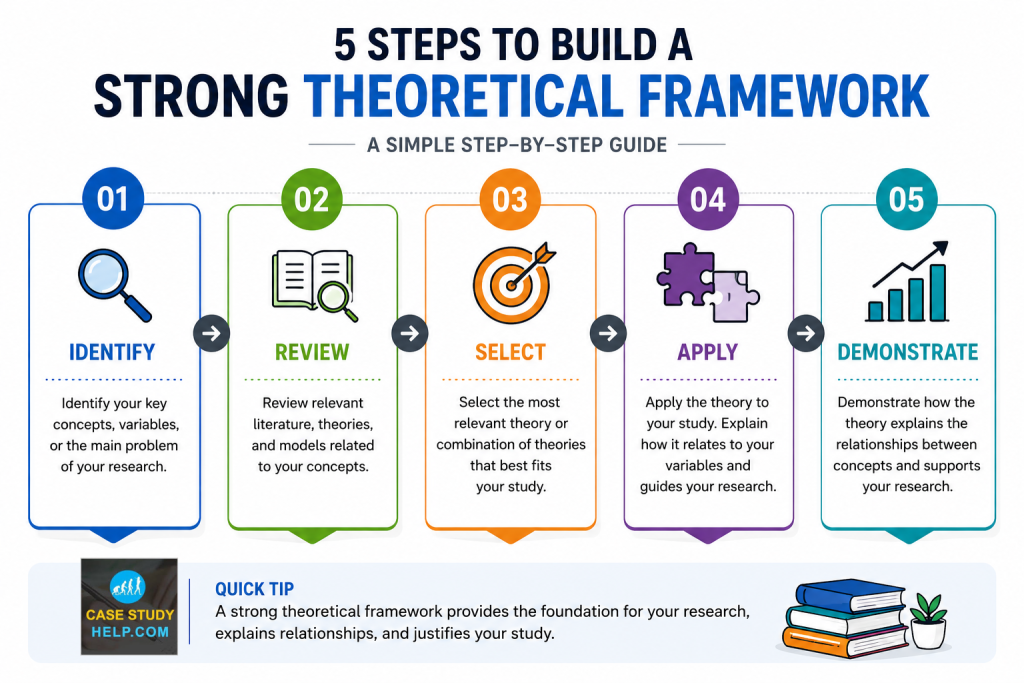
Yet, a strong theoretical framework is crucial. It presents the branches for your research and helps to explain the relationships between key concepts, and gives direction to your study. Without it, your research may lack focus and a clear basis for analysis.
The good news is that developing a theoretical framework doesn’t have to be intimidating. Once you understand its purpose and follow a structured approach, the process becomes much more manageable.
Struggling to develop a theoretical framework for your research? Our academic experts can help you create a clear, well-structured framework that aligns perfectly with your research objectives.
Understanding the Theoretical Framework and Its Core Meaning
Before you dive in, it’s important to understand what a theoretical framework really is and why it matters.
At its core, a theoretical framework is an arranged way of connecting your research to existing knowledge and theories. Think of it as a lens through which you view your study—it helps you explain why the research problem exists, what factors influence it, and how different concepts relate to each other.
In Simpler Terms, a Theoretical Framework:
- Guides your Research – It provides direction for your study and helps you focus on the most relevant variables.
- Explains Relationships – It shows how key concepts in your research are connected and why they matter.
- Supports your Analysis – It provides a foundation for interpreting your findings and comparing them with previous studies so that you can get the accurate reserach not duplicate.
Example: If you’re studying the impact of social media on student productivity, your framework might draw from behavioral psychology and media consumption theories. These theories provide a lens for understanding how and why social media habits affect study patterns.
In short, the theoretical framework is the backbone of your research, keeping it structured, meaningful, and grounded in established knowledge.
Conceptual vs. Theoretical Framework
It’s important to distinguish between these two:
- Theoretical Framework: Anchors your research in existing, well-established theories.
- Conceptual Framework: Maps how you will adapt or test those theories in your specific study. It often outlines the specific variables you want to measure.
| Feature | Theoretical Framework | Conceptual Framework |
|---|---|---|
| Definition | A structured guide based on existing theories to explain phenomena and support research. | A visual or written representation showing how concepts relate in the specific context of the study. |
| Purpose | Anchors the research to established theories and provides a foundation for analysis. | Shows how concepts are applied or tested in the research, often highlighting variables and relationships. |
| Basis | Built on pre-existing, well-established theories. | Built on the researcher’s understanding of concepts and how they interact in the study. |
| Focus | Broad, general explanations of phenomena. | Specific to the research problem, detailing variables and relationships. |
| Components | Theories, assumptions, principles, and prior research. | Concepts, variables, relationships, and hypotheses. |
| Visual Representation | Rarely visual; mainly theoretical explanations. | Often represented as diagrams, flowcharts, or models. |
| Usage | Provides the rationale behind choosing concepts and interpreting results. | Guides research design, data collection, and analysis. |
Exploring Core Concepts and Common Theories
What Are Core Concepts?
Core concepts are the fundamental building blocks of your research. They identify the scope of your study and guide the selection of relevant theories.
Example: In any study on remote work and employee performance, the core concepts might include:
- Remote work
- Employee productivity
- Job satisfaction
- Work-life balance
- Organizational support
Clearly defining these concepts ensures consistency throughout the research process.
Why Theories Matter
Theories provide established explanations for why certain phenomena occur. They help interpret observations, develop hypotheses, and connect variables. A well-chosen theory for further reseasons mention here:
- Provides a logical foundation
- Explains relationships among variables
- Supports research questions and hypotheses
- Guides data collection and analysis
- Strengthens credibility
Common Theories in Theoretical Frameworks
Social Learning Theory (Albert Bandura) – Learning through observation and interaction.
Example: Students adopting online learning behaviors through peer observation.
Theory of Planned Behavior (Icek Ajzen) – How attitudes, social norms, and perceived control influence intentions.
Example: Factors affecting consumers’ willingness to buy eco-friendly products.
Technology Acceptance Model (Fred Davis) – Explains adoption of technology based on usefulness and ease of use.
Example: Students adopting online learning platforms.
Maslow’s Hierarchy of Needs (Abraham Maslow) – Motivation driven by a hierarchy from basic needs to self-actualization.
Example: Factors influencing employee motivation.
Diffusion of Innovations (Everett Rogers) – How ideas and technologies spread over time.
Example: Adoption of digital payment systems by small businesses.
Constructivist Learning Theory (Jean Piaget & Lev Vygotsky) – Knowledge is actively constructed through experience.
Example: Effectiveness of project-based learning in higher education.
Choosing the Right Theory: It’s about relevance, not popularity. Align your theory with core concepts and objectives for a strong framework.
5 Simple Steps to Master Your Theoretical Framework
Step 1: Identify Relevant Theories
Here, you need to identify the key variables and concepts. Here, you need to extract the primary concept or phenomenon from the problem statement or research topic.
These concepts are the very building blocks of your theoretical framework. Theoretical framework example: if your research topic is the pros and cons of online education, your key concepts will be education and online education.
Example: For “pros and cons of online education,” the key concepts are education and online learning.
Step 2: Define and Connect Key Concepts
Here, you need to clearly outline how the variables in your research theory interact, with greater focus on your field of study.
Ex: if the main concept of your field of study or research is motivation, then your theory is that a lack of motivation negatively impacts employee performance, ultimately leading to a drop in productivity.
Example: If studying motivation, examine how a lack of motivation impacts employee performance and productivity.
Step 3: Structure Your Framework Logically
Writing a good research paper structure means breaking down the very complicated problems into smaller, manageable Mutually Exclusive, Collectively Exhaustive (MECE) components.
Here, you can use tools like “Management Consulted Frameworks Guide” for your templates. To build your own, you need to start with the branch and core objectives logically.
To define your core objective, you need to clarify your goals.
Example: here, you need to state exactly which device you are trying to build or what issues you want to solve. Thus, alas, you need to write a very clear hypothesis or problem statement before mapping.
Step 4: Review Existing Literature
Here, you need to search the academic literature using your key concepts to identify prior theories that address or explain your research problem.
Example: while writing your literature review, you can come across theories like “Herzberg’s Two-Factor Theory, ” which is related to the corporate factors like job satisfaction vs dissatisfaction, or several self-determination theories that focus on competence, relatedness, and autonomy.
Step 5: Show How Your Research Extends Knowledge
In this step, you need to explain to your readers how your field of study can draw on existing ideas. Here, you can espie any preexisting theory in a new context by combining several theories or by challenging any old assumption. End your framework by emphasizing that self-determination theory is good for office workers. Here, your research will be highly relevant to the modern hybrid rowing model or any remote-working model in the IT (Information Technology) sector for assessing the unique impacts on staff productivity.
Example: Applying Self-Determination Theory to hybrid or remote work models in IT to assess productivity.
Thus, you have an idea of how to write a theoretical framework from the steps mentioned above. You need to apply it as effectively as possible for the best results.
Applying the Framework to Your Research
Altima, any resize framework always requires structuring your study using preexisting theories or a network of conceptual models. Here, you need to start by defining your key variables and research questions.
Then, you need to select a well-established framework for analyzing your data and ensuring your methodology is sound. You can always successfully apply your framework to your dissertation, thesis, or projects. Its 4 structured approach is as follows:
Identify Core Variables –
Here, you need to review your problem statement and retract the basic concepts you intend to study. You also need to define your expectations by distinguishing between the independent variables, such as the cause and the inputs, and the dependent variables, such as the effect and the outcomes.
Select the Framework –
The theories that you study in an established format, like Mallow’s hierarchy. It can be used if you are expanding, testing, or even challenging any known theory. It is a conceptual framework developed from a literature review that visually maps the specific relationship you expect to find among these variables.
Build a Visual Model –
It is creating a flowchart or mind map of your various elements, physically showing how they interact. Here, you need to include the intervening or the moderating variables.
Align Methodology with Analysis –
You need to conduct data collection using your own framework to precisely determine what type of data you need to collect for the survey work and what you will do with it. This includes all types of data integration, and amaze the results refer back to the assumptions of your framework to explain why your findings have emerged and how they relate to the broader field.
Common Mistakes to Avoid
A strong theoretical network and a very good research methodology move your study towards your existing knowledge. To build a strong foundation, you need to avoid certain common pitfalls, which are explained as follows:
Less Alignment with the Core Research Problem:
The theoretical framework needs to address your very specific research questions directly. It is a mistake to choose a trendy theory to sound impressive, as it does not address your research problem directly. You can fix this by ensuring that every model or theory you include in the maps has direct hypotheses, variables, and intended outcomes.
Overloading the Theories:
More does not assure better when it comes to your theoretical backing. Here, the mistake is in adding many disconnected concepts into a single framework. This makes our study feel scattered and fractured. You can always fix this by sticking to only one or two theories to explain best the relationship between your socially inherent or deaden variables.
Not Define The Variables Or The Key Cadets Fully:
Assuming that your readers share your understanding of academic jargon is a mistake. Suppose you mention concepts like cognitive theory without clearly operating within the context of your specific field of study. You can definitely fix it by explicitly defining how you are exceeding any construct, including how these concepts can be measured in practice in your methodology.
Ignoring the Context:
All the theories have era limits. The lists are by applying any theory in any particular demography or cultural setting. This can be fixed by acknowledging the boundary and scope of your chosen theory and justifying them accordingly.
No Canyon I Between the Methodology and the Framework:
A framework is of no use if it is added only in the introductory part. Here, the mistake lies in failing to provide a strong theoretical background while abandoning the concepts that support your data analysis to interpret your own findings. A stem can fix this by ensuring that measurement data collection instruments, such as research, surveys, questions, data, information, and interview protocols and strategies, are derived from your own theoretical framework.
Tips to Strengthen Your Framework
Academic writing tips to strengthen your theoretical framework are as follows:
Clearly Defining the Key Concepts:
Do not assume that universal terms are understood; certain concepts may have multiple meanings. Always try to extract the core variables from the probe statement and the research questions.
Evaluate and Synthesize Critically:
A good theoretical framework is not just a summary list; it also requires a very good critical analysis. Thus, you always need to compare and contrast the different theatrical approaches as proposed by the scholars.
Conveying the Theory to your Partial Research Design:
Always avoid assuming that the underlying theory is mentioned in the introduction but not in the data analysis.
If you Build up a Multidisciplinary Foundation:
If no single theory adequately explains your research problem, combine theories from various fields. Here, you can opt for a robust, step-by-step demonstration of the map variables to define the concepts and connect them clearly to your own specific research question.
Conclusion: Recap of the 5 Steps
Mastering your theoretical framework requires:
- Selecting relevant theories
- Identifying core variables
- Structuring a visual model
- Aligning methodology with analysis
- Showing how your research extends knowledge
Follow these steps carefully, and your theoretical framework will provide a strong, clear foundation for your study.
Final Tip: Keep It Clear, Not Complicated
The very final rip this blog is to write a very clear theoretical research paper and not make it complicated. You can well understand from this blog that writing the best thieve conceit is not very easy. Thus, you always need the best online research writing services from the best provider. casestudyhelp.com is your top choice in this regard.
Why Casestuyhelp.com?
- We are always the best online thesis writing help service provider
- 24/7 hours of academic research support are provided via our official website
- Top grades are always assumed in our dissertation guidance services online
- The research methodology assistance service online provided by us is always a hundred percent free of any plagiarism
- The papers are always free of any errors
- Only customized services are provided by us as per the unique requirements of your college or university
- The service charges are also very reasonable
All our clients in the world are very happy and satisfied with our services, so join us soon.
Author Bio:

Hi, I’m Lyana Jones, a passionate academic writer and the voice behind this blog. With years of experience in crafting academic content, I’m here to help you turn your ideas into polished, high-quality work.
Whether you need guidance or full writing support, I’m always happy to help. Reach out anytime and get expertly written, plagiarism-free content with perfect grammar and structure.