
The Kotter change model management theory was first proposed by Dr John P Kotter after observing and analyzing the many leaders who were very much struggling to apply necessary changes in their own companies.
The Kotter’s 8-Step Model focuses on creating an easy procedure to change the application for heling the organization to transform. It is an 8 step procedure that helps the managers as well the organizational leaders in implementing necessary changes in the business successfully.
Source: Casestudyhelp.com
This model asp emphasizes on making a long term change to oversee the resistance towards the changes via an 8 step change management framework. In this bog we will discuss about a complete guide to Kotter’s 8-Step Model.
Overview of Kotter’s 8-Step Model
It is a systematic change management framework model that is need to minimize the disruption by ensuring all the project success by reducing the resistance of the employees via effective management tools.
Minimizing the Resistance:
It is a structured model that allows the leaders nod the company managers for commuting with potential changes in an added way with their employees.
Mitigating the Risks:
this organized approach for the changes to implement helps in defang the probable issues in adduced stage like technical updates, cultural changes working environment changes, etc. This is done to prevent any financial losses in the future.
Quicker Transitions:
systematic organizational changes in any company management process to reduce the downtime of the operation. This model is used to solve all the human halers easily and quickly for organizational benefits in the long run.
Thus, it can be concluded that the Kotter’s change management theory is used for a very successful implementation of organizational change by overcoming or solving any employee resistance.
Need expert help applying Kotter’s 8-Step Change Model in your assignment? Get professional support from Case Study Help for Change Management Assignments, Kotter Model Case Studies, Leadership & Organizational Change Projects, and Business Management Reports—with 100% plagiarism-free content and on-time delivery.
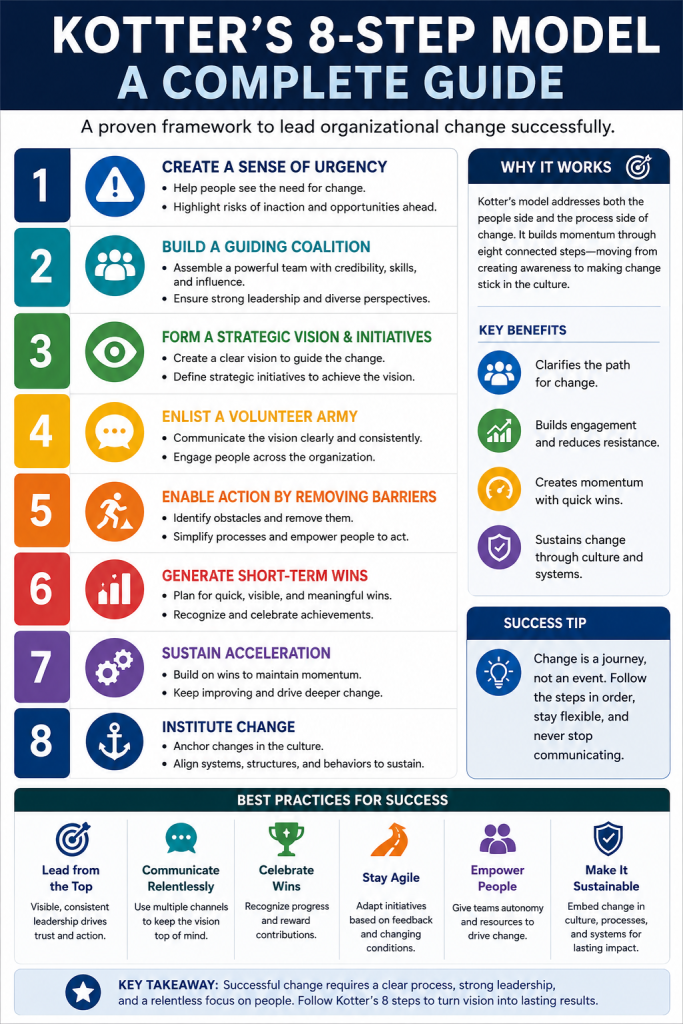
Step-by-Step Explanation of Kotter’s 8 Steps
The 8 steps of the Kotters organizational change management model are explained below:
1. Creating Urgency:
As per this model, the organization leaders need to create a feeling of urgency to manage all types of oganizational changes for an effective management.
It starts by recognizing all the potential opportunities or even risks that need prompt action. Here, the manager also needs to communicate with the subordinates regarding the crucial changes.
They can also use the satirical data he to build up trust for motivating the employees for a change.
2. Building up a Guiding Coalition:
At this stage of this change management process the leader of the change makes a very influential as well strong team for managing the change to lead the whole initiative.
In order to implement the change very much successfully, the manger needs to form a very strong team by excluding skilled and expert individuals from each of these levels.
This might include the leers with an author or staffs who are in a strong positon to influence the collegues to work as a team collaborately for aping new policies in the organization.
3. Forming a Strategic Vision:
This is the very next step of this model, where the manager creates a very much captivating vision to motivate the employees for applying new changes in the company.
This new vision needs to contain the desired result potential to derma the very key strategies for achieving the desired outcomes.
This can reduce the employee resistance for the change since they will start to realize how these positive char can really be good for the employee as well the organization in the long run or near future.
But here your vision also need to align with the personal benefit and goals of the employees.
4. Communicating Your Vision:
After the previous step, it is very much imprint to communicate your vision with the employees quite frequently. Thus, you will be build up an employee support for the proposed changes.
It also ensures that all the company staff are in a similar stage and are aware of the final vision of the organization.
Thus, it is a very crucial phase since it is the first step to help in ensuring that everyone knows about the proposed plan and also know their roles in the managerial change process.
5. Eliminative the Obstacles and Enabling the Actions:
In this step, you need to identify the potential obstacle that is important to implement the plan without any major errors.
Thus, it is a very crucial phase of the implementing change in organizations to help the manages to identify as well eliminate the potential organizational problems.
These obstacles can be like many types like cultural, structure or even employee resistance. If you can eliminate these issues it will help you to make an easy atmosphere where echo the employees can feel very much involved in a very friendly organizational environment. This will help them to feel motivated too.
6. Making Short Term Wins:
A business transformation strategy is a quite long term process and so the results can be delayed and this can often demotivate your employees.
Thus, in this phase it is always very much important to celebrate even little wins to motivate the staff. These smaller and quicker wins are good evidences to show how the changes can lead to bright organizational outcomes.
7. Consolidating the Improvements:
This is one of the most crucial steps of the kotters change model to help in maintaining the concretion and allowing the change in the whole team work with a best laid plan.
This phase needs to scale the shifts all over the organization to analyse quick wins and addressing the rest of the issues.
8. Anchoring the Cultural Changes:
This is the last step of the business process improvement and is used to ensure that the new methods, behaviors or the mind sets are very much rooted in their corporate organizational culture.
This step also ends reinforcing all the changes by integrating them to achieve the organizations success. It is also the responsivity of the manager to ensue that if become an important part of the company operations.
Make your conclusion stronger by showing how change becomes a permanent part of business operations. Get expert help from Case Study Help for Kotter’s 8-Step Model assignments, Change Management case studies, and Organizational Development reports—with well-structured analysis and proper referencing.
Real-World Case Study of Kotter’s Model
The most well-known real world case study of the koters model is that of the Ford motor company by the CEO Alan mullaly in the year 2006. This happened when the company suffer 17 billon loss. This is explained step by step below:
Phase 1: creating a climatic change working on the employees he claimed that the current finical cousin of Ford is very much unsustainable and near banktpcy and the operation methods are to be changed with immediate effect.
- Froing a Guiding Coalition: he established a very much mandatory business plan on a weekly basis with the direct reports. This made the executive leaders quite isolated from the departments and triggered a cult of full transparency.
- Developing a Clear Strategy and Vision: the ford corporate focus was changed into a singular as well very much scanner vision of :one ford.:
- Engaging and Enabling the Whole Organization: this happened by communicative with the chase vision by employing a global workforce.
- Removing the Obstacles: in order to clear the massive road blocks Mullaly made a tough decision to sell the luxury car bans like the Volvo, jaguar, etc. He also replaced the resonant excites who opposed his decision.
- Generating Short Time Wins: ford successfully tracked the newly designed as well fuel efficient ford fusion car model.
- Implementing as Well Systematic the Transformation: this is consolidating the gains to make more changes. Mullay leverage the success of the ford fusion to overhaul the manufacturing platform of ford.
- Anchoring the New Approach: the transparency with data driven as well the cross functional collaborations became permanent norm in ford.
Source: Casestudyhelp.com
Best Practices for Implementing Kotter’s Model
Best practices of the leadership development strategies are as follows:
- Do not only rely on the numbers instead use the best storytelling. Get a good idea of the market rarities to alter the examples of customer friction.
- Ensure the group within the coalition be influential stakeholders from different levels of the organization like the senior executives.
- Always keep console and you cannot communicate your vision as well the reasons for it in any 5 minutes or even less.
- Always make your vision very much visible and transparent. Try to communicate it constantly and integrating it with dual performances and recognition.
- Always audit and remove the outdated process very much actively by using the best technologies.
- Try to select cost effective low risk as well undeniable targets. Reward and celibate with the whole team.
- Try to avoid in declaring any victory too early. Here, you can use the cruelty that you have gained from the initial susses.
- Ensure newer habits that are embed in train the protocol by promotion criteria with the dial operations to change the old organizational essays and practices
Change leadership can help you a lot in reaching the organizational goals.
Advantages and Limitations of Kotter’s Model
The benefits of kotters model change management tools are as follows:
- Precise Format: the model proves a very clear picture as well as a statute road map to allow all types of strategic change models and management. It makes the whole change process very much simpler for both the employees and the managers.
- More Leaders Centric: the change management model always focuses on the leadership coalition to drive for the change. The model always recognizes the importance of strong leadership. Thus, you can handle the changes much more effectively.
- Enabling Obstacle Management: the leadership model of koter envisages the amuses of the potential barriers in advance to remove hen for making the whole process smoother. Thus, the companies can handle these issues in a better way.
Cons of kotters model are as follows:
- Lengthy Process: the process is quite rigid that limited the flexibility to a very large extent especially if the company needs fast changes. The structure might reduce the possibly of the organization to get a fast track change.
- Linear Progression: the model always falls a rigid process which is very difficult to follow.
- Avoiding Personal Barriers: while the project management frameworks model focuses more on the barriers of the firm it avoid the issues f the individual staff which they face during the transformation process.
Kotter’s Model vs Other Change Management Frameworks
Kotter’s 8 step model:
- Core Focus: this incudes leadership, urgency, cultural anchoring and communication.
- 8 steps: to establish an urgency by forming a coalition guideline vision genre and empowering action.
- Best Used For: huge scale corporate transformations with mergers, acquisitions and changing organizational cultures.
- The Limitations: this is largely hierarchical as well linear model and it can also be rigid at hierarchy level with the fast moving changes.
Prosci ADKAR Model:
The 5 elements of this model are as follows:
- Awareness: this is he need for the change, desire is to participate and knowledge to know how to change. Ability to implement the skills and reinforcement to sustain it.
In comparison to kottrs model which tells the leaders what steps to execute in any organization while the ADKAR model tells the managers what the individuals need to feel and learn. This works for the front line ups by making much easier for measuring individual progress.
It is best used for minimizing any individual sane while tracking the exact blockers as employee faces.

Source: Casestudyhelp.com
Conclusion
Thus, we can see in this log that writing the best assignment on the employee engagement techniques for the organisational changes is not an easy job. Thus, you always need the best online digital transformation strategy assignment writing service provider in this regard. The casestudyhelp.com is the best chief for you in this regard.
Why Casestudyhelp.com?
- We always provide you with the top quality assignment content
- Our experts will always provide you with the best online assignments on kotters model
- Top grades are always assured by us
- 24×7 hours of online help and support are available on our website
- The service charges are also very much reasonable
- Only customized services are provided as per the unique requirement of your college or university
- All the work is completed on time and submitted before the deadlines
All our clients across the world are very happy and satisfied with our services and join us very soon. Check Our Valuable Customers Reviews
Author Bio:

Hi, I’m Lyana Jones, a passionate academic writer and the voice behind this blog. With years of experience in crafting academic content, I’m here to help you turn your ideas into polished, high-quality work.
Whether you need guidance or full writing support, I’m always happy to help. Reach out anytime and get expertly written, plagiarism-free content with perfect grammar and structure.