
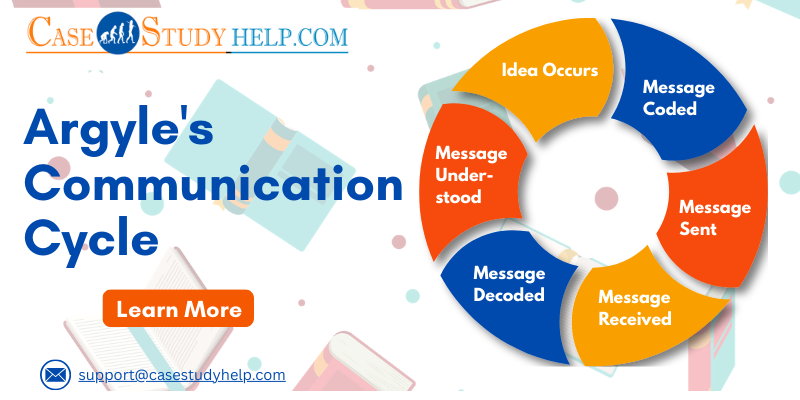
Argyle’s Communication Cycle is the procedure to outline a 2 say process of communication and it also focuses on its interactive as well cyclical nature. This consists of 6 essential stages- idea, coded message, transmitted message, received message, decoded message and finally last iteration of the message.
Source: Casestudyhelp
The Argyle’s communication theory illustrates that any effective communication is about the real understanding of the receiver to provide a feedback for more clarity. In this blog we will discuss about the 6 stages of Argyles communication with the re; life applications.
Understanding models like Argyle’s Communication Cycle helps students develop stronger communication and analytical skills in academic studies. If you need support with related assignments or case analyses, CaseStudyHelp.com offers expert help in essays, case studies, research proposals, and dissertations across multiple subjects, ensuring clear concepts, quality work, and timely delivery.
Argyle’s Communication Cycle: A Brief Overview
The argyle’s theory of communication explains the communication procedure were its words as a very continuing 2 way process. The theory was for developed by Charles Berner in the year 1965 and was later modified by the British psychologist Michael Argyle.
The Argyle’s communication cycle 1972 breaks down the circle of communication in to 6 main stages – idea, encode message, set, received as well understood. This cycle shows that the communication do not compromise by only wring or seeking but also by the way the message is really interpreted by others.

Source: Casestudyhelp
Who Was Michael Argyle?
Michael Argyle was a British social psychologist who is best known for his researches on human communication as well social interaction. His study was mainly related to the way people use the verbal as well nonverbal communication in the daily situations.
His theory mainly focuses on all the practical firms of communication mainly the face to face comes. Moreover, his proposed theories are mainly used in psychology, education as well professional training.
6 Stages of Argyle’s Communication Cycle
Stage 1: Idea Occurs
- Here, the communication starts when the sender has a “message” or “idea” that they need to share. It is always very much necessary that the idea is crystal clear before conveying.
- A data that is well defined can act as a basis for all the subsequent steps in the communication cycle. This specifies what the sender intends to convey to the receiver.
Stage 2: Message Coded
- Here, the sender converts his idea into a message. It nest the proper selecti0n of proper tone, words as well non verbal signals for the best articulation of this “message”.
- This proper encoding always ensures that the message is very much clearly understood by your receiver.
- This step of argyle’s communication cycle transforms the abstract thoughts into very much concrete messages that can be transmitted effectively to the receiver.
Stage 3: Message Sent
- Here, the message is transmitted via any chosen channel like speaking, gesture or writing. This transmission method also effects the message quality.
- There can also be external factors like noise, technical issues or many misunderstandings to effect its clarity.
- Thus, it is always very much essential to select the most suitable as well reliable channel in order to minimize the disruptions.
Stage 4: Message Received
- Here, the receiver gets the message. This step is very much crucial and needs the top engagement with an active mind. This also involves the art of active listening.
- Thus, without a good attention, the message parts can be missed or eve ignored to reduce the good effective communication.
Stage 5: Message Decoded
- This is the last step of the Argyle’s communication cycle. Here, the receiver decodes the “message” in order to interpret its real meaning. It also needs a very deep analysis of the tone, context and language.
- The background of the receiver like knowledge, experience and present the emotional sate influences the message interpretation.
- Thus, there are many possibilities of misinterpretations if the message is a bit unclear or the receiver is lacing the context.
Stage 6: Message Understood
- It is the final stage where the receiver commend the message as the sender is intended. Here, the effective communication is achieved while the message is interpret as intended by the sender.
- Moreover, this stage needs a feedback from the receiver in order to confirm proper understanding with a climbed of all types of ambiguities.
These are all the essential states of the Argyle communication theory. If you understand the theory very well it will rely assist you with a better application in varied fields. Thus, you always need to have crystal clear idea regarding each and every stage mentioned above.
Source: Casestudyhelp
Application of Argyle’s Communication Cycle
In Healthcare
This is the patient provider interaction. It is used for ensuring anything, for example, the diagnosis of a doctor is very much well understood by the patient. But if a patient feels confused, that is the feedback, the doctor adjust their explanation by closing the gap to understanding. If things improve like quality of are in nursing homes by the staff, family or residue they are effected communicating with words.
In Education
The teachers apply this cycle for structuring the lessons, sharing knowledge and ensuring the students to comprehend the material. Ex: it helps in providing very clear understanding as well soliciting imitate and constructive feedback for checking the understanding.
In Business
In business or work place the communication improves the interactions with the employees for boosting job satisfaction and productivity. This is also used in minimizing the misunderstandings in tram meetings, project management. Etc.
Personal relationships and conflict resolution: this model helps the individuals ti identify where the breakdown of communications take place ex: faulty encoding, lack of feedback.
This also allows families or partners to identify the misinterpretations in order to foster better understanding via structured dialogues.
Pros and Cons of the Argyle’s Model
Pros:
- Focusing on 2 way communication: this model focuses on very continuous exchange of feedback by ensuing that the message is not just sent but very much well understood by your recipient.
- Indemnifying the communication breakdowns: this 6 step process of forming, encoding, and transmitting, receiving, decoding and understanding massage makes it easier to pin point where the communication error has occurred.
- Practical application: this is very much applicable in all the interpersonal settings like there or nursing where oiling the report and clarifying the messages is viral.
- Reflecting real life interaction: this model captures the natural flow of the back and forth conversations by making it reliable in daily communication.
- Encouraging active listening: this cycle highlights the significance of the receiver’s information and iteration by fostering a reflective listening.
Cons:
- Oversimplification: the model presents very simple and a liner flow that often fails to capture the complexity of the human emotion with context as well external noise that can interfere with communication.
- Needs active participation: it needs both the sender and the receiver to be engaged that is always not possible in cases where it involves any kind of distress, disability or any Lack of interest.
- Ignoring the cultural and the environmental factors: This mode; does not account enough for how the environmental or the cultural differences can alter the message interpretations.
- Limitations for mass communication: it is mostly made for one to one interaction and is often lesser effective in explaining the fast paced media, digital or mass communication.
- Focusing on rationality: it assumes that the participants are very much rational or even ignoring all the rational barriers that cam hinder the understanding.

Source: Casestudyhelp
Comparison with Other Communication Models
Tuckman’s Model
This communication model explains how the different groups development communicate with each other over time. This includes 5 stages as stated below:
- Forming: here the members get to know each other
- Storming: Involving conflicts where there are clash of the options
- Norming: here the group established norms or rules
- Performing: this is the stage of produce team work
- Adjourning: it marks the end of any group stage
Shannon-Weaver Model
This is a very classic communication model theory that describes the communication cycle as a linear procedure. It involves the following:
- Sender: one who encodes or send any message
- Channel: it is the way via with a massage travels through any digital device
- Receiver: this is the person who interest or decodes any message
- Noise: it refers to any disruptions that can distort one even block any message.
This massage is very much needed to understand how the technical issues or the distortions effect any communication. Thus, this model is widely used in medic and telecommunications for improving his massage clarity in the best possible way route or manner.
Conclusion
Thus, we can see that understanding the Argyle’s Communication Cycle and opting it effectively for your assignment papers is not an easy task. Thus, you always need the bet online do my assignment for me service from a reputed provider. The Casestudyhelp.com is always the top choice for you in this regard.
Why Casestudyhelp.com?
- We are always the very best online assignment helper in UK
- We have the top academic experts online to provide you with quality services
- Our expert will always avoid plagiarism in academic writing
- 24×7 hots of online help and service is provided via our official website
- Top grades are always assured by us
- We are always dedicated to your services
- Only customized service are provided y us
- Charge are also quite reasonable
All our clients are very happy and satisfied with our services. Thus, join us soon.
After reading this blog on “Understanding Argyle’s Communication Cycle: Stages and Model”, if you are still want to know briefly about “Argyle’s Communication Cycle” , visit our official website Casestudyhelp.com for instant assistance from experts.


Author Bio:

Hi, I am Lyana Jones, the author of this blog. I am a well-experienced academic writer. We’ll help make your writing shine.
Please get in touch with us anytime, tell us about your topic, and receive a 100% plagiarism-free paper with impeccable grammar and formatting.