
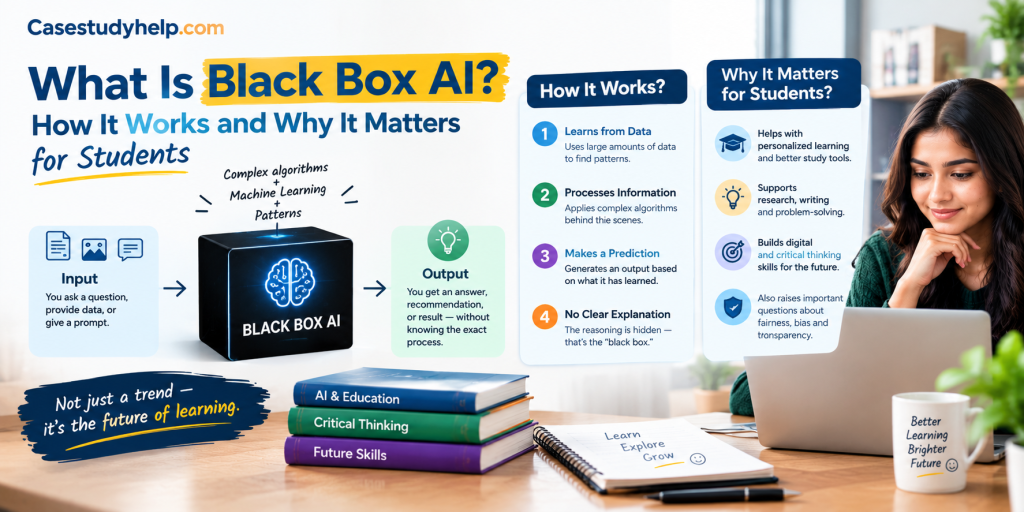
Today is the digital age and the age of AI (Artificial Intelligence). A black box is a special type of AI system where the decision pathways, internal workings, and logic are hidden from the user.
What Is Black Box AI?
Here, you provide an input like an image, text prompt, or resume and receive an output like code, a classification, or even a diagnosis. The model’s exact steps in between are very opaque.
Why Is AI Called a “Black Box”?
AI is called a “black box: since its internal decision-making process is very much hidden and unreachable to humans. Although you can see clearly the input here and the outputs are given back.
How Does Black Box AI Work?
Most black box AI systems work under the hood and deeply rest on the large of the multi layered artificial neural network in the following manner:
- Data Processing or The Input Layer: here, all the raw data, like text, images, or program code, are fed into the network and normalized.
- Feature Extraction or The Hidden Layers: here, the data passes through billions of interconnected “neutrons” across multiple hidden layers. Each layer uses numerical values known as weights and biases to recognize complex patterns, such as software syntax rules, visual features, or semantics.
- Output Generation: the final layers combine these computed patterns to produce a classification, prediction, or gated response.
- Backpropagation and Train: this model learn through a massive dater. It adjusts its internal parameters constantly with backpropagation. Thus, it forms a feedback loop to minimize all the errors. These parameters often scale into billions, making it impossible to trace outputs back to any single logical line.
Black Box AI vs. Explainable AI
Key differences between Black Box AI vs. Explainable AI are as follows:
Black box AI
- Transparency: low transparency, internal weights and math are inscrutable
- Accuracy: it is mostly quite high for various complex patterns like natural language, images, and huge data sets.
- Comprehension Depth: it lacks deep comprehension, robustness in spotting errors, and awareness of hidden biases.
- Common Uses: large language models, computer vision, complex financial forecasting, and general pattern recognition.
Explainable AI
- Transparency: it is highly interpretable and provides clear reasons, confidence scores, and the most contributing factors for each decision.
- Accuracy vs. Trade-Off: it can sometimes sacrifice a small amount of predictive performance or require smaller model designs.
- Core Tools: it utilizes various tool like SHAP (Shapley Additive explanations), LIME (Local Interpretable Model-agnostic Explanations), And The Attrition Visualization to Get the Future Importance.
- Common Use Cases: credit scoring, healthcare diagnosis, legal justice, corporate environment. Etc.
Examples of Black Box AI Students Use Every Day
A few examples of the black box artificial intelligence used by students daily are as follows:
- Large Language Models (LLMs)
- Large Language Models (LLMs)
Tools like ChatGPT, Google Gemini, and Anthropic Claude synthesize essays, summarize textbooks, and answer research questions. You type a prompt (input) and get a full response (output), but you cannot see how the underlying neural network selected or weighted specific words.
Coding Assistants:
Platforms like the black box and the gigabit co-pilot are gendered auto-complete or even the convent code from the session and the text prompts. They also save time on programming assignments, and they function as the black box side: they spit out functional code that exposes internal operational logic.
The Adaptive Learning Platform:
Edutech apps and video platforms like YouTube, plus science or Math software with tutorial videos, quizzes, and other content based on student history. These algorithms decide what content will be shown next.
Plagiarism and Automated Grading Systems:
Schools use automated software to scan essays for originality. These systems can detect plagiarism and output scores for texts.
Why Does Black Box AI Matter for Students?
Black box AI is an important part of artificial intelligence for students. It matters a lot for students, basically as a practical coding platform and as a study assistant. This is a reminder to understand how the system works. This is explained below:
Student Benefits for Coding Learning:
- Strong Coding Help: software tools like Blackbox AI can help students a lot with writing, debugging, and translating code across multiple programming languages very swiftly.
- Error Analysis: you can also use it to scan screenshots or error messages to figure out why your script isn’t working.
- Clarification of Concept: it breaks down complex academic or technical concepts step by step, like a good tutor.
The Concept of Black Box in Education:
- Clear Decision-Making: in AI, the “black box” means you can always see the input and output of the neural network, but the internal logic is hidden.
- AI Literacy Risk: if you blindly rely on black-box tools, it can lead to superficial learning, where you copy answers or code without understanding the underlying logic or math.
- Accuracy and Bias: since the inner workings are hidden, these models can also miss errors without being checked.
The Benefits of Black Box AI in Education
There are many benefits of AI for students. These are as follows:
- Automated Feedback and Grading: these systems can quickly process many student assignments, like tests and essays, saving teachers a lot of time.
- Scalable Data Processing: black-box models excel at breaking down huge datasets faster than humans.
- Outcome Prediction and Early Warning: machine learning algorithms can analyze huge student data.
- Adaptive Tutoring: neural networks can adjust to different problem-solving styles.
- Reduced Cognitive Load: it handles tasks like data sorting and low-level pattern recognition, freeing educators from additional workload.
The Risks and Limitations of Black Box AI
There are certain risks and limitations to how black box AI works. Some are explained below:
- Lack of AI transparency and explain ability
- Amplification of hidden biases
- Legal vacuum and accountability
- Regulatory and compliance failures
- Security and the vulnerability of the blind spots
- Main Limitations of black-box machine learning are as follows:
- Accuracy vs. interest trade-off
- Difficulties in debugging
- Misplaced trust and overreliance
Can Students Trust AI-Generated Answers?
Students cannot trust AI-generated answers entirely, as it uses large models that predict word patterns rather than actual verified facts, with fabricated information popularly known as software “hallucinations”.
How Students Can Use Black Box AI Responsibly
Students can use AI responsibly in the following ways:
- Asking for the explanation and not just answers
- Debugging the errors manually
- Cross-checking and verifying the outputs
- Following the rules of academic integrity
- Protecting private data
How Teachers and Schools Can Address AI Transparency
Teachers and schools can address AI ethics by the following means:
- Clarifying the AI policies
- Approving the tool list
- Communicating about data privacy
- Effective communication by teachers
- Teacher practices in the classroom:
- Disclosure of the syllabus
- Teacher modelling
- AI transparency statements and the surveys
- Critical fact-checking
The Future of Black Box AI in Education
Bias and Opaque Decision-Making: AI models act as an unbiased gatekeeper, reinforcing Global North perspectives and perpetuating data biases.
Shifting Towards the Open Box: teachers and researchers are moving from passive consumption to a quest to strengthen the underlying framework. This critically tells students to audit AI outputs rather than rely on them blindly.
The Black Box Assessment: the higher education sector is rethinking academic integrity by focusing on evaluation and the learning process, and also on handling and rectifying mistakes.
Hardware and EduTech Interactions: the latest AI tools, like AI-powered smart blackboards, are part of the global digital technology that converts human handwriting into live digital graphs and interactive 3D models.
Making the Choice Policy: educational institutions face a strong divide between accepting the closed, walled gardens that are driven by the commercial tech giants, who demand open access to the measurement framework, as well as transparency to the digital public.
Key Takeaways for Students
Students can benefit greatly from proper use of explainable AI, which often supports better AI decision-making. AI machine learning models can help both teachers and students in modern education.
So, making the best use of AI in education is not easy. So, you need the best online education or academic help service provider. The casestudyhelp.com is always the top choice for you in this respect.