
Publishing your own research paper is one of the best steps in your academic journal. At any level of education, from school to doctoral studies, producing a high-quality and original research paper increases your credibility when your work is visibly published.”
In this blog, we will discuss about, a detailed guide for choosing the right journal for publication Add UK-specific or discipline-specific guidance.
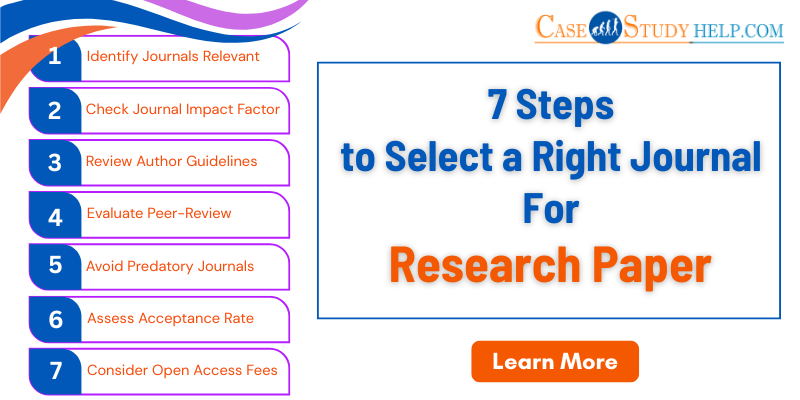
Source: Casestudyhelp
Introduction to Academic Journal Selection
Publishing an academic journal is a big milestone to achieve your entry in a big research community. We do this to demonstrate that our work has been thoroughly reviewed and contributes original value to the field.
For the PhD and the masters students the journal publication is all about true credibility. A thoroughly peer-reviewed research paper shows that your work meets scholarly standards and can withstand future critical evaluation.
Unlined the dissertations or the essays the journal articles are designed for the global audiences. They are circulated in the academic databases to influence the future research with new collaborations or opportunities foe farther study funding.
Struggling to choose the right academic journal for your research? Get expert guidance to improve acceptance chances and submit your manuscript with confidence.
Understanding the Scope and Aims of a Journal
The aim of a journal, defines its mission as well the goals while its scope gives the details of the specific methodologies, subjects, types of articles, etc. Ex: reviews, software tools, original research, etc.
If you understand this, it will help you to match your work to any right publication by ensuring its relevance and maximizing the impact and minimize the chances of any rejection by the publisher.
Aim and Scope
Aim
This is the mission and purpose and the “why” behind the journal and its contribute to any field like fostering consideration independence or supporting equity in healthcare.
Scope:
This deals with the subject and consent of the publishing material. These are the specific topics and the boundaries that detail what are area are actually covered like marketing, environment, finance, etc.
Types of Articles:
These are very much specific accepted frays like the reviews, research arucles, data reports, or the method articles and also those which are not accepted like case studies, hypotheses papers, etc.
Editorial Standards:
These are the criteria for selection like methodology soundness, originality and also the ethical considerations.
You can find it an in any journal website in the sections like “aims and scope” “about” you can also check the recent sampler articles and editorials.
It is needed due to the following reasons:
- Relevance: it ensures that your research aligns with the focus of the journal by increasing the acceptance chances
- Impact: this places your work in front of your target audiences by maximizing its influence.
- Efficiency: it helps you to avoid wasting much time by submitting to the journals that are not much suitable by preventing any rejections.
Types of Academic Journals
The academic journals vary a lot demanding up on various factors like focus, adduce, content type, and are also broadly classified into scoreless articles like peer view, or trade or industry focused articles from the professionals with industrial knowledge.
The popular categories here include less technical, general public or even the non expert authors. Here, are also some sterilized cases and areas like biology, medicine, conference proceedings, multidisciplinary articles review journals, etc.
Various article forays here like the case studies, original research as well the opinion pieces each of these serve specific academic functions:
Scholarly or the Article Journals: these types of journals are written by the experts and for the experts. It features the peer reviewed as well the original research with a number of citations. Like subject specializations of nature and sciences.
Trade Journals: it is used by the professionals in various industries like engineers and nurses. It provides many practical insights without any formal citations. Ex: the nursing times
Popular Magazine’s: it is aimed for the general public by focusing on the very recent events like entertainment with the non expert authors and without the usage of any citations.
Open access (OA): It is fee to read but often funded by the author by fees by promoting the wider disseminate for the author.
Hybrid: It is a type of mix where some of the articled are the OA within any subscription journal or the pay per article of the leader.
If you want to check free research paper and journal then check Google Scholars
- The Research Articles: It presents the original findings
- Case Studies: In depth analysis of any specific person, phenomenon or event
- Review Articles: It synthesizes the equating literature on any topic
- Theoretical Papers: It proposes new models o theories
- Methodological Papers: it gives the details on new research techies.
- Sepia Journals: it faces on a very narrow niche are like chemical biology or Frilly.
- Multidisciplinary Journals: these are the published researches that cross mile fields like the scientific reports.
- The Scientific Journals: these focus on the formal and the natural vises like the sieve of nature.
- Humanist Journals: it focus on literature, art and philosophy like the arson screen
- Research Articles: these are the original research reports that present new findings from fresh studies or experiments.
- Review Articles: it synthesizes and summarizes any existing research topic.
- The Case Studies: these are the details of the cases in the fields of management, medicine, etc.
- Editorials or the Commentaries: these are the pieces of opinion or insights
- Conferee Proceedings: these are the papers that are presented at the academic conferences.
- The Open Access Journals: the make the articles very freely available online
- The Subscription Based Journals: these need payment for accessing
How to Select a Journal for Research Paper?
Step 1: Identify Journals Relevant to Your Research Area
Before you start with the databases or the journal list, you end to fits in the presents theme of the journal. By identifying your research area and the target audiences, you can narrow down your choices.
Ex: if your journal is on the climate narrates in the post colonial fiction literature, or an environmental study it might write an interdisciplinary journal to welcome or address the cross field discussions. Thus, you always been to choose a journal that always matches with your target audiences.
Step 2: Check Journal Impact Factor and Rankings
Ranked or indexed journals gain recognition in major academic databases such as Web of Science and Scopus. As a result, your article becomes more searchable and widely viewed.
Indexing refers to listing journals in trusted academic databases to ensure editorial quality and scholarly standards.
Step 3: Review Author Guidelines Carefully
Before the final submissions ales read the authors instructions very carefully. It need to detail the formatting requirements, word can, referring style, etc.
Some of the journals might require a cover letter for publication. It explains why your article suits the ridership.
Step 4: Evaluate Peer-Review and Publication Time
Some of the journals have very fast review procedure while few others can take 6 or more months for responding. Here, you ca consider your own academic time line.
Suppose you are applying for detrital or PhD degree you might prefer the journals with shorter turn around time. The timeline are mostly listed on the official website of the journal.
Step 5: Avoid Predatory Journals
In order to avoid the predatory journals you always need to be suspicious of the unsolicited emails and check for the profess websites with very clear peer review, verify the editorial boards as well confirm the indexing in reputed databases like Scopus or the DOAJ.
Step 6: Assess Acceptance Rate and Rejection Risk
In order to assess the acceptance rate and the rejection risk you need to look for the author guidelines, aims and scope in order to ensure your alignment of work.
You need to contact he editor or the editorial office which can provide an estimation of the journal submissions as received annually vs the published article to calculate an approximate acceptance rate.
You can also use database tools like the “Elsevier Journal Insights” for providing data on the abeyance rates for any journal port folio of a specific journal.
Step 7: Consider Open Access Fees and Copyright
The Open Access (OA) publishing shifts are the cost of publication from the readers subscriptions to the author, funding body or unction via any Article Processing Charges (APCs).
On return, the author usually retain the copyright and gran the specific and broad resale of the premises via the licenses to make the Cowrie Common licenses.
Follow our Research Paper Writing Guide by Case Study Help to plan, write, and format your paper correctly, and submit high-quality academic work with confidence.
Tools and Databases to Find the Right Journal
In order to find the right journal you can use specific tools like Taylor & Francis Journal, Taylor & Francis Journal Suggested, Wiley journal founder, etc. The journal matching tools are as follows:
- Jane: this is good for the journals of the biomedical field
- Taylor & Francis Journal Suggested: here you need to enter your abstract for the suggested citation and titles
- Journal Finder: this is spring your keywords o abstract for finding suitable compare matrices.
- Springier Nature: it finds the matches within the springier and nature
- End Note Manuscript Matches: it suggests the journals and provides all the impact factors of the related articles.
- IEEE Publication Recommender: it is used for their engineering and the mourner science papers.
Common Mistakes Researchers Make When Choosing a Journal
Even good journals can get rejected for many reasons. Some of these are as follows:
- Submitting a journal that is not in your research area
- Ignoring the major referencing and formatting needs
- Overlooking the publication fees that are hidden
- Submitting any discretion chapter without any article format
- Falling into the trap of the predatory publishers who ate promising instant results
- Failure to verify proper alignment: This occurs when authors do not carefully review journal guidelines or check the reference lists of cited journals.
- Lack of quality assessment: Always evaluate journal indexing in databases such as Web of Science or Scopus, along with impact metrics and peer-review procedures.
- Insufficient peer consultation: Discuss your work with colleagues or mentors to obtain honest, constructive, and valuable feedback.
- Nor balancing the goals properly: you always need to find a peat balance in your journal quality and thirties of our paper so it shod each the right audiences.
Journal Impact Factor Explained
A journal impact factor or the JIF measures the influence of any journal by calculating the average of the number of times with its recent articled as cited.
Journal Citation Reports publishes this metric annually, where a higher value indicates greater influence within a field. It calculates the value by dividing citations from the past two years by the number of citable items.
Academic Publishing Tips
The academic publishing tips below are essential for getting your journal articles accepted by publishers. These are as follows:
- Thus, we can see in this bog that whiting a good academic article for global publication is not an easy job.
- Thus, you receive the best support to get your articles accepted by publishing houses and earn top grades.
- The casestudyhelp.com is the top choice for you in top research.
Why Casestudyhelp.com?
- We are always the providers of the online journal tips and tricks
- We assure you of top grades with a high acceptance rate.
- Only original cogent is provided by us without any plagiarism
- A flawless count is provided by us
- Round the clock services are available via our website
- The specific guidelines of your institute are stretchy followed by us
- The top team of experts work with us in a team who guide you for best research paper writing Help
Clients all over the word are very happy and satisfied with or services. Thus, join us very soon.
FAQs on Choosing the Right Journal for Publication
- What is the research paper publication process?
- What are the main journal submission guidelines?
- What is the difference between open-access journals and paid journals?
- How to Avoid predatory journals ?
- What are the Scopus indexed journals ?
- What is the importance of the Peer-reviewed journals ?
- Give an idea on the Research paper acceptance rate ?
After reading this blog on “A Step-by-Step Guide to Choosing the Right Journal for Publication”, if you are still facing difficulties with choosing a correct journal for your research, visit our official website Casestudyhelp.com for instant assistance from experts.


Author Bio:

Hi, I am Lyana Jones, the author of this blog. I am a well-experienced academic writer. We’ll help make your writing shine.
Please get in touch with us anytime, tell us about your topic, and receive a 100% plagiarism-free paper with impeccable grammar and formatting.