
Gibbs Reflective Cycle
Graham Gibbs first introduced the Gibbs Reflective Cycle in his 1988 book to support experimental learning and was strongly influenced by the Kolb Learning Cycle.
Gibbs designed this model to help people learn from their actions. It is used as a tool to help people think about their experiences, analyze them, and learn in the future.
The ultimate goal of the Gibbs Reflective Model is to help people reflect step by step to understand what went well and what did not, and to identify ways to improve. In this blog, we will discuss how to use the Gibbs model of reflection most effectively to avoid mistakes.
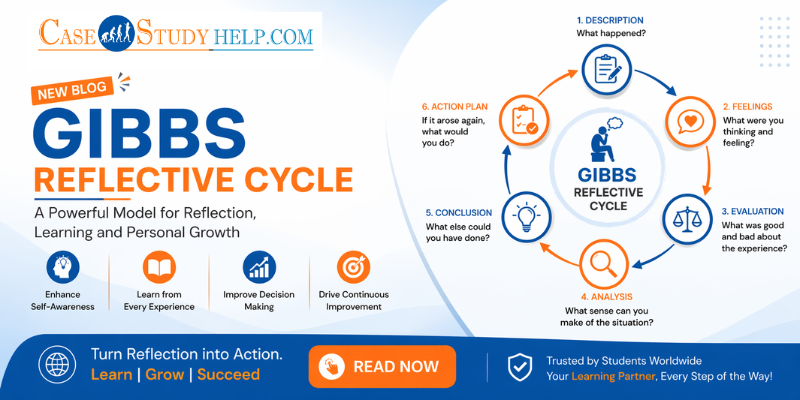
Key Characteristics of Gibbs Reflective Cycle
The key characteristics of the Gibbs reflective writing model are as follows:
- Cyclical nature: It is a loop-like thing that repeats the reflection on many ongoing situations, like clinical practices, rather than only on one-off events.
- A structured 6-stage process: this cycle guides the user through a specific order to ensure comprehensive reflection. These 6 stages are description, feelings, evaluation, analysis, conclusion, and action plan.
- Focussing on feelings and emotions: unlike many models that focus only on actions, this Gibbs model places great importance on exploring the reflector’s emotional state and on acknowledging that feeling.
- Balanced evaluation: the model prompts you to analyze both successes and failures, reducing the risk of focusing only on the negatives.
- Acton orienteers: the main goal of this model is to produce a good “action plan” by ensuring that the ratio results improve in future practices, rather than just theoretical thought.
- Adaptability: Although this model is most commonly used in nursing, it can also be applied to team management, personal development, and education.
Start reflecting smarter with the Gibbs Reflective Cycle. Turn your experiences into powerful learning opportunities, improve decision-making, and achieve continuous growth. Explore expert guidance now at Casestudyhelp.com and take the next step toward academic and professional success!
👉 Get Help Today
Understanding Gibbs Reflective Cycle and Its Origin
The reflective learning cycle developed by Gibbs in 1988 is a 6-stage, structured framework that helps individuals learn from their experiences.
This model promotes structured reclusion for personal and professional development by helping users break down various situations, process their emotions, and create actionable, improved behavior in the future.
Origin and purpose
- Origin: The Gibbs reflective model was first developed by Graham Gibbs in 1988 as a very structured approach to reflective practice and is widely used in education. professional training, such as teaching and nursing.
- Purpose: This cycle moves from just betting to simple reflecting by linking the feelings to many analytical and actionable sets to transform experience into learning.
The Six Stages of Gibbs Reflective Cycle Explained
Gibbs Reflective Cycle stages are as follows:
Stage 1 : description: A third-year nursing student who was in charge of a night shift at a hospital in London had another nurse to care for 23 ill patients in the hospital ward. A doctor told her to give a patient another .
1 mg of digoxin, a heart stimulant, to relieve the symptoms of serious congestive heart failure, as well as his breathing issues. The nurse had never given such a high dose of strong medicine before.
She cross-checked the bottle and the dosage with the doctor, who gave his consent, along with another senior nurse. The patient’s heart rate was checked every hour. At midnight, the nurse suddenly realized that he had given 10 times the amount of the said medicine.
She also confirmed this with the other nurse, then filed an incident report with the doctor and the patient’s relatives. Fortunately, the patient did not suffer any bad effects and made a full recovery.
Stage 2 : feelings: a nurse had been on night shifts for a long period of time. That day, the Paine ward was very busy, with only 2 nurses to care for, and she was in charge of Mr. X, who was quite ill and needed constant monitoring.
She had never given such a high dose of the medicine Dicoumarol to any patient before, and so she was quite reluctant to administer such high-dose meds to the patients.
Moreover, she checked with an on-call doctor, who reviewed the medication and approved it. But she was nervous after giving such a high dose and kept checking the patient’s pulse.
But the doctor was under a lot of stress and rushing around the ward. He has recently moved from the pediatric ward.
Stage 3 : Evaluation: she was not blamed for the incident, and he was not assured either. But the patient, Mr. X, made a full recovery, and his relatives were also very understanding of these circumstances.
The matron was also impressed with her and said she took her responsibilities seriously and made it clear. She was very much petrified by her errors and started watching the patient the whole night for any bad signs of an overdose. She also could not sleep the next day and returned to the next shift to find Mr. X doing much better.
Stage 4 : Analysis: This incidentally terrified the nurse, since she had done everything right and consulted the doctor to check the dosage.
She also did not have any idea what led her to take the overdose later on. The concerned doctor also agrees that I have shown home 4 tablets.
She also realized that all patients depend on them and have faith in them. But that incident was merely a byproduct of the other linked inky-like tiredness, overwork, and misunderstandings.
Stage 5 : conclusion: It was reviewed that the patient, Mr. X, survived the overdose.
Stage 6 : action: she has now become more vigilant regarding the drugs with proper dosage.
Get expert assignment help tailored to your requirements. Boost your grades, save time, and achieve academic success with us today!
👉 Get Expert Help Today
Example of Gibbs Reflective Cycle in Practice
Gibbs Reflective Cycle example from nursing:
Description: A nurse informs the relative and family ere regarding the worsening condition of any patient. The family may become angry, accuse the nurse, and create a tense situation.
Feelings: the nurse can become anxious and refrain from the amber but also feel empathetic towards the family.
Evaluation: the positive was that an essential was ultimately delivered, and the negative was that she should not take the tense, difficult situation so to heart.
Analysis: the family’s reaction was one of shock and fear rather than any personal thing. The nurse realized that and provided emotional support.
Conclusion: The nurse learned that technical communication needs to be delivered with empathy.
Action plan: the nurse can decide to seek training in handling difficult situations and prepare themselves to remain emotionally calm in such situations.
Importance of Gibbs Reflective Cycle in Reflective Writing
- It provides a very clear structure for writing: this model breaks down the reflection process into 6 distilled stages to cover all the major points.
- Encouraging deeper self-reflection guides one beyond surface-level reflections to delve into deeper thoughts.
- Connection theory to practice: With this model, you can always reflect on how these cancellations or tires can be applied practically.
- Facilitates improvement: it always focuses on the room for future improvement, turning them into proactive tools.
- Promotes emotional intelligence: this reveals model helps you become more thoughtful in your responses to situations.
Also checkout: Argyle’s Communication Cycle: Stages, Model and Theory
Steps to Write a Reflective Essay Using Gibbs Reflective Model
Reflection writing always allows you to look back on your previous experiences and extract to extract very meaningful insights that contribute to both professional and personal growth.
The main purpose of this model in an essay is to provide a framework that guides the reflection steps.
- Introduction: Start this part as an outline of your work
- Description: always describe your experiences with a lot of context for the readers.
- Feelings: reflect your own emotional response by exploring your feelings.
- Evaluation: Analyze both the positive and negative aspects of your experience.
- Analysis: go deeper into any situation to undertake more thoroughly
- Conclusion: summarize everything from your experience.
- Acton plan: outline what you need to do differently for future success.
Thus, when you understand the stages of the Gibbs reflective model as mentioned above, you can write a good essay very easily by stating your reflective experiences very clearly.
Also read: A Complete Guide to Writing an Essay
Advantages and Disadvantages of Gibbs Reflective Cycle
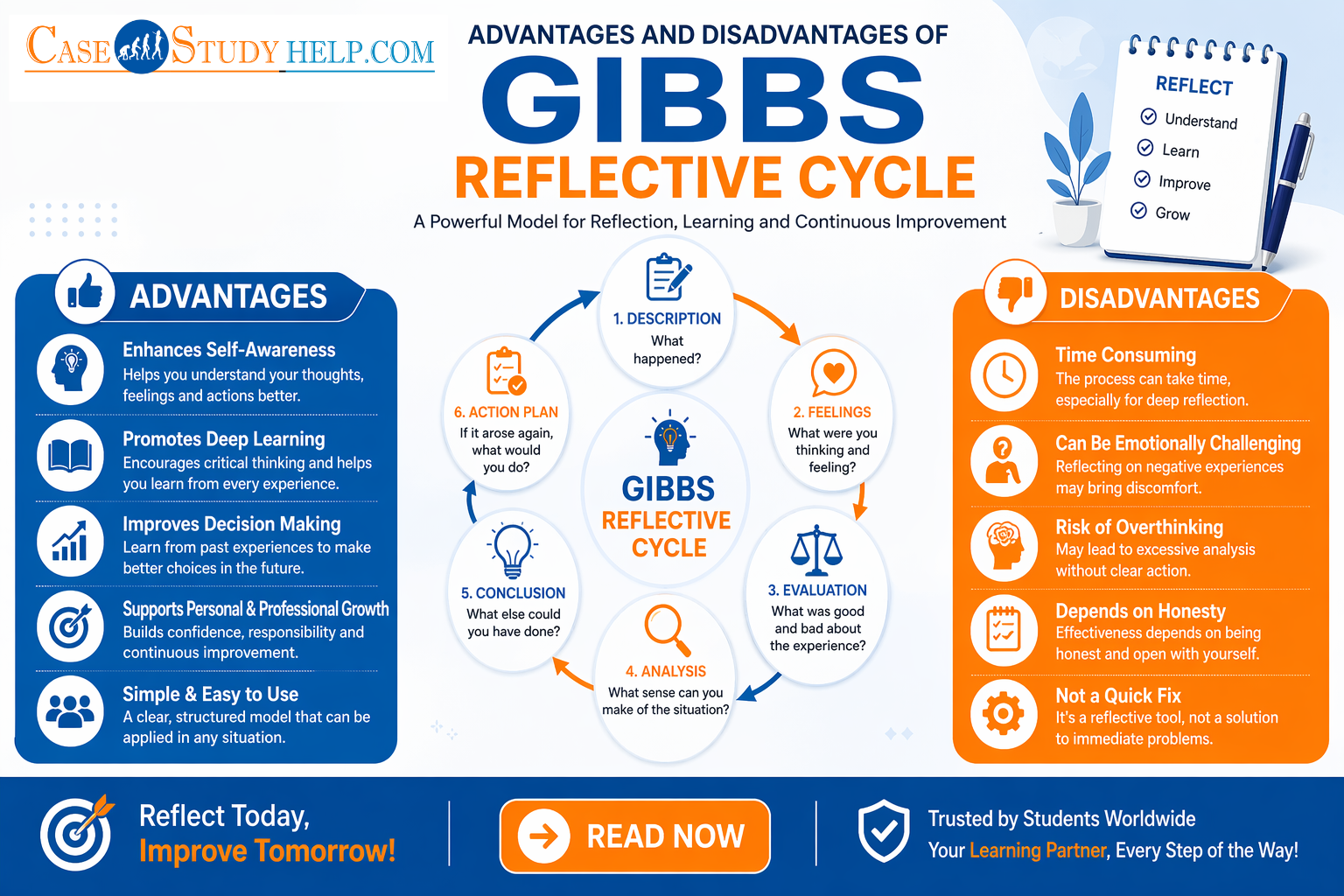
Advantages:
- It is very clear as well as very easy to follow
- It always promotes very deep thinking
- Helps you grow
- The model is always very versatile and adaptable
Disadvantages:
- It can sometimes feel too rigid or less practical
- Can also lead to a shallow reflection
- Focusses too much on any single individual
- Takes a lot of time
How to Cite or Reference Gibbs Reflective Cycle
A Gibbs Reflective Cycle uses APA and Harvard citations. It also uses detection, parent rival citation, and source codes too.
For you: Citation Styles Guide: APA, MLA, Chicago, IEEE, Turabian Explained
Implementing Gibbs Reflective Cycle in Organizations
- First, the subject in your organization needs to understand the model very well. You always need to have a very clear idea of the model before implementing it in your organization’s operations.
- Fostering a reflective culture: you need to motivate Verona in your organization to make the reflective model part of your daily lives.
- Promoting the exchange of reflective ideas: you need to establish a good space within the organization where people can share and express their own thoughts. This can be done via team meetings and conferences.
- Assessments and feedback: You need to conduct regular reviews of how the Gibbs reflective cycle is used in modern organizations and provide feedback on its use.
- Scholarly, the reflective practices: leaders and managers should practice self-reflection. Thus, they will be encouraged to do for themselves.
Using Gibbs Reflective Cycle in Educational Settings
The Gibbs Reflective Cycle explanation can be fully implemented in the fields of education in the following ways:
- Incorporating the reflective raita into the study curriculum: if you include Gibbs reflective practice in your study curriculum, it can be made a regular part of your training at school and college levels.
- Real-world scenarios: education institutes can use case studies or even real-life scenarios to apply this reflective model and make it more practical. Thus, they will have a solid foundation for their future professional careers.
- Promoting student skills: This model can be a very useful tool for enhancing students’ specific skills. This will enable their future leadership skills and personal development.
- Reflective journal: You can also motivate students by keeping one yourself. This will help them apply the Gibbs-Gibbs cycle and develop future corporate leadership skills.
- Arranging workshops for professional development: institutions can also hold workshops to focus on teaching, guide students through the Gibbs Reflective Cycle, and support their personal and professional growth.
Thus, all the key areas mentioned above can drive working professionals across organizations and students at different levels of education to develop critical skills in their careers in the long run.
Order now for professional academic support! Get reliable College Assignment Help, University Assignment Help, and Explication Essay Writing Service. Meet deadlines, improve grades, and achieve success with Case Study Help today.
👉 Place your order now
Get Expert Assistance with Gibbs Reflective Model
Thus, you can see in this blog that using the Gibbs reflective model effectively to write academic assignments is not easy. Thus, you always need the very best online reflective essay writing help service from a reputable provider. The casestudyhelp.com is always the top choice for you in this respect.
Why Casestudyhelp.com?
- We will always provide you with the very best online reflective report writing help
- Top grades are always assured in the one academic writing service provided by us
- Our experts will provide you with a very clear idea of the Gibbs reflection framework
- Only a hundred percent plagiarism-free and error-free services are provided by us
- Charges are also quite reasonable
Thus, join us as soon as possible.
Author Bio:

Hi, I’m Lyana Jones, a passionate academic writer and the voice behind this blog. With years of experience in crafting academic content, I’m here to help you turn your ideas into polished, high-quality work.
Whether you need guidance or full writing support, I’m always happy to help. Reach out anytime and get expertly written, plagiarism-free content with perfect grammar and structure.