
Reflection Paper at a Glance
- Purpose: Analyze and reflect on an experience, reading, event or learning activity
- Typical structure: Introduction → Description → Reflection/Analysis → Conclusion
- Writing style: Personal but academically supported
- Common perspective: First person where appropriate
- Key focus: What happened, what you learned, why it matters and how it changed your thinking
What Is A Reflection Paper?
A reflection paper is a personal experience where you analyze and share your thoughts on a topic, such as a book, incident, or lecture, explaining how it influenced your perspective. Unlike other academic essays, it allows personal opinions with no right or wrong answers. In this blog, we will discuss the Reflection Paper Guide.
Students at any academic level often do the reflection by writing their own thoughts about any particular event or work. At the later stage, while you compose the cover letter, you can also highlight your past experiences and share them with your readers.
When you writing a Reflection Understand the Assignment Question?
- What are you being asked to reflect on?
- Is the reflection about an experience?
- A lecture?
- A book/article?
- A placement?
- A project?
- A group activity?
- A professional experience?
You also need to know how to structure these types of essays, which can help you simplify the whole writing process. The key considerations to write a Reflection Paper: A reflection paper is a writing piece that shares your own thoughts or reactions to the experience on the topic. You need to start your reflection paper by asking a question and noting down your ideas on the given subject matter. Brainstorming is the primary key to writing a good reflection paper.
Practical Example that Would be Helpful
Weak approach:
I attended a group presentation and it was interesting.
Better reflective approach:
Working on the group presentation made me realise that effective communication involves more than sharing ideas. I initially focused on completing my own section, but feedback from my teammates showed me that coordinating the overall presentation was equally important.
Stuck with Your Reflection Paper ?
Get Expert Help to Organize Your Ideas and Reflect Deeply on Your Experience!

Reflection Paper Structure that Would Helpful for Writing
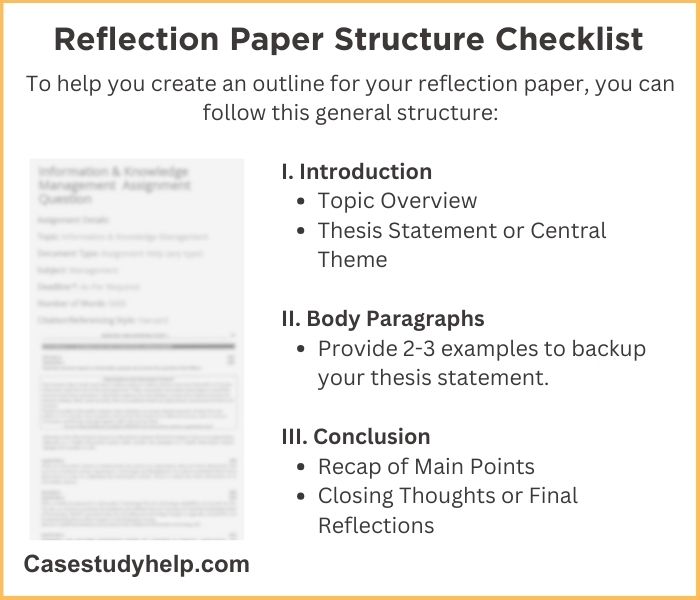
Introduction: It’s the section where you have to answers the all points according to your topic/title.
- Introduce the topic/experience
- Provide context
- State the main reflection or learning point
Description: Here you have to describe the all questions with suitable statements that fulfill your topic.
- What happened?
- What was your role?
- What were you expecting?
Reflection & Analysis: this is the major part where you have to analysis and reflect your experience about that specific thing.
- What did you think/feel?
- Why did you respond that way?
- What did you learn?
- What theories/concepts explain the experience?
Evaluation: It’s the part where you have to remind and evaluate all the points mentioned about that specific area.
- What went well?
- What didn’t?
- What would you do differently?
Conclusion: it’s the last things that you have to make impressive because mostly tutors seen the first and last paragraphs of any reflections paper it shows the how the paper written.
- Summarise your learning
- Explain how your thinking changed
- Mention future application
Looking for finest and professional Reflection Paper assignment help online? Choose Casestudyhelp.com and enjoy high-quality assignment paper at lowest rate!
You should Aware of Which Reflection Model Should You Use?
Gibbs’ Reflective Cycle:
It’s the Reflective Cycle with six-step framework created by Graham Gibbs in 1988 to help people learn from their experiences. And use it when they writing any reflection paper.
- Description: Just share the fact of what happened in that particular thing without judging or analyzing
- Feelings: Present your honest thought and emotions during and after the event happened.
- Evaluation: Discuss the was good or positive? What was difficult or negative?
- Analysis: Make sensible statement of the situation by looking at why things happened the way they did.
- Conclusion: Summarize what you have learned and what you could have done differently from them.
- Action Plan: Write down specific steps to tackle a similar situation better way for next time.
Kolb’s Experiential Learning Cycle:
It is an experiential learning cycle is a four-stage model that showing we learn best by doing, reflecting, thinking, and testing.
- Concrete Experience: You have a new hands-on experience or take part in an activity.
- Reflective Observation: You step back and think about or reflect on what just happened.
- Abstract Conceptualization: You form new ideas, general rules, or theories based on your reflections.
- Active Experimentation: You apply your new approaches and theories in a real-world setting to see what happens next.
Schön’s Reflective Practice:
Donald Schön’s reflective practice is a professional framework that helps individuals learn from their hands-on work by thinking about what they do while they are doing it and reviewing it afterward.
- Reflection-in-action: “Thinking on your feet.” This happens in the middle of an situation when something unexpected occurs, prompting you to adjust your approach right away.
- Reflection-on-action: Looking backward after an event has finished analyzing why you made certain choices, what worked, and what you should change next time.
Also Check – A Complete Guide to Schon’s Reflective Model
Then tell students when each model is useful.
A comparison table would be particularly useful:
| Model | Best for | Main stages |
| Gibbs | Structured Academic Reflection | 6 stages |
| Kolb | Learning Through Experience | 4 stages |
| Schön | Professional Practice | 2 concepts |
This table will be helpful for you to chose the correct model for your reflections paper writing according to the requirement. if you need further guidance.
Reflection Paper Example
Descriptive writing
Our group had difficulty communicating. We had several meetings and eventually completed the project.
Reflective writing
I initially assumed that dividing the workload would automatically make our group more efficient. However, I realized that assigning tasks without establishing regular communication created inconsistencies between our sections. This experience changed my understanding of teamwork because I began to see coordination as equally important as task allocation.
Why Is The Second Version Better?
As you seen the second version is reflective writing that includes the all points and makes your wiring strong rather than a simple descriptive writing.
- Describes the experience
- Shows personal thinking
- Identifies learning
- Explains change
- Demonstrates analysis
Quick Reflection-Writing Formula – The 5-Question Reflection Formula
Ask:
What happened?
↓
How did I respond?
↓
Why did I respond that way?
↓
What did I learn?
↓
What will I do differently next time?
Reflection Paper Template
How Long Should a Reflection Paper Be?
Students often ask: “How long is a reflection paper?” The answer is that it varies. Your writing should match the paper guidelines for each & every course module.
Some professors ask for one page; others want three. The phrases you use will vary depending on the subject and purpose of that paper.
Always read the instructions. Add a short conclusion summarizing your thoughts, even if the assignment is brief.
Common Mistakes in Reflection Papers
- Only describing what happened
- Turning the paper into a diary
- Spending too much space summarizing the experience
- Making unsupported claims
- Ignoring the assignment question
- Using a reflection model mechanically
- Saying “I learned a lot” without explaining what changed
- Writing a conclusion that introduces a completely new idea
- Ignoring the required referencing style
Tips for Writing a Strong Reflection Paper
Writing a strong reflection paper requires more than simply describing what happened. You should explain your experience, analyze its significance, and show what you learned from it. Use these practical tips to make your reflection clear, meaningful, and academically effective:
- Understand the Assignment: Read the guidelines carefully and identify the topic, required format, word count, and learning objectives.
- Choose a Meaningful Experience: Select an experience, reading, event, or topic that gave you something valuable to think about or learn from.
- Use the First Person: Using “I” is generally appropriate because a reflection paper focuses on your personal thoughts, experiences, and learning.
- Go Beyond Description: Do not only explain what happened. Discuss why it happened, how it affected you, and what you learned from it.
- Include Critical Analysis: Connect your experience to relevant theories, concepts, course materials, or academic sources when required.
- Be Honest and Specific: Give clear examples of your reactions, challenges, decisions, and changes in perspective.
- Organize your IdeasLogically: Use an introduction, well-developed body paragraphs, and a conclusion to create a clear flow.
- Use Headings when Appropriate: Headings can make longer reflection papers easier to navigate and understand.
- Support your Ideas with Evidence: If you refer to theories, research, or other authors, cite them using the required referencing style.
- Proofread before Submitting: Check your grammar, spelling, sentence structure, citations, and formatting to ensure your final paper is polished.
- Focus on Learning and Growth: End by explaining how the experience changed your understanding and how you might apply what you learned in the future.
FAQ by Students & Professionals
Q.1 How long should a reflection paper be?
A reflection paper is usually 1–3 pages long, depending on the assignment requirements. It should be long enough to clearly explain your thoughts, feelings, and learning.
Q.2 Can I use “I” in a reflection paper?
Yes. Using “I” is appropriate in a reflection paper because you are sharing your personal thoughts, feelings, and experiences. First-person writing is appropriate.
Q.3 Is a reflection paper the same as an essay?
Not exactly. A reflection paper is a type of essay, but it focuses mainly on your personal thoughts, feelings, experiences, and what you learned from them.
Q.4 Do reflection papers need references?
Not always. References are needed if you use information, ideas, or quotes from other sources. If the reflection is based only on your personal experiences and thoughts, references may not be required.
Q.5 What should the introduction of a reflection paper include?
The introduction should include the topic or experience being reflected on, some background information, and a main idea or thesis that shows what you learned or realized.
Q.6 How do I start a reflection paper?
You can start a reflection paper by introducing the experience or topic and briefly explaining why it was meaningful to you.
Q.7 Can I use headings in a reflection paper?
Yes. Headings can be used in a reflection paper to organize different sections and make your ideas easier to follow but mostly it’s depends on the university/assignment requirements.
Q.8 What is the difference between reflective and descriptive writing?
Reflective writing focuses on your thoughts, feelings, experiences, and what you learned, while descriptive writing focuses on describing a person, place, event, or experience in detail.
Final Tips
Writing a strong Critical Reflection Paper can be challenging, especially when you need to combine personal reflection with critical analysis, academic evidence, and proper structure. Understanding the requirements and knowing how to reflect critically can make the writing process much easier.
For students who need additional academic guidance, Case Study Help provides resources and support for reflective writing and other university assignments. Whether you are studying in the USA, UK, Australia, Canada, or elsewhere, you can find practical guidance to help you understand academic requirements, improve your writing, and approach your assignments with greater confidence.
Author Bio:

Expertise: Reflection Paper Guide-Academic Strategy -Scholar Writing.
I am a research & reflection paper writing specialist with a Master’s in English Literature from University of Cambridge. I renovate difficult academic requirements into clear, comprehensive guides, helping student’s master strategic and analytical thinking and achieve clarity in their scholarly work. Last updated on September 2026. We believe everyone should updates about new information’s.