
If we talk about the modern changes in management, in the field of business as well other program related to management we use the Bridges Transition Model. It works as a key framework that you need to learn in your business management degree course.
What is Bridges Transition Model of Change? Detailed Guide
In test blog we will discuss about why the employed of an organization resist to the managerial changes and how the organization can promote the long term char adaptions and possible adjustments.
Struggling to understand change management theories?
This detailed guide on the Bridges Transition Model is perfect for MBA and business students who want clear explanations and practical examples. Start learning today and stay ahead in your studies!
👉 Get Help Today
Understanding the Bridges Transition Model
The William Bridges Transition Model is a sort of change management framework to floe a 3 star produce for helping the individuals as the organizations lead the groups as well the staff via the changing times. This model as first developed by William Bridges in the year 199 it as implementation the managerial field.
For many yare a lot of lades, organization and the man me confutes are using the Bridges Change Model for understanding the human side of the managerial change.
Main idea of this model focuses on the internal managerial transition that the people for via the change of time of the organizational changes instead the change of the external situation. The key features are as follows:
- Change: this is the situation like new policy, new job or any new system
- Transition: this id any psychological change that how the people emotionally adopt.
Organizatikbal change I anything that can instantly happen. But on the hand transition is a slower process and I an emotional journey that you need to navigate fir getting used to the current reality.
When the manager of by organization addresses this emotional journey it becomes easier for them to plan the major organizational goals with the readiness of the staffs.
Transition vs Change: What’s the Key Difference?
You always need to understand very well the Transition vs Change in management while you are doing your assigns in business Management subject. Although they mostly occur together the change and the transition are 2 very different things.
Change is an outside event and tis cam be a very new organizational strategy like a merger, now predictor recruiting a new leader. This is about wat nee to happy and also what happens quite quickly.
On the other hand, transition is lawyer n inside process. This really means how the people mentally and emotionally adjust to the chaffs. This is about lawn the old ways and getting adjusted to any new organizational situation.
In order to make the change really work well, the leaders need to focus first on heling the people via transition. It I abitur supporting your employees in order to keep them morally up, helping them in the adaptation proves and to create a stronger as well more resilient teams.
Need help with APA, Harvard, or MLA referencing in UAE universities?
Get expert Help with Assignments, Dissertations Writing Services, Editing & Proofreading Service, and plagiarism-free formatting—trusted academic help tailored for UAE students.
👉 Get Assignment Help today!
Major Stages in the Bridges Transition Process
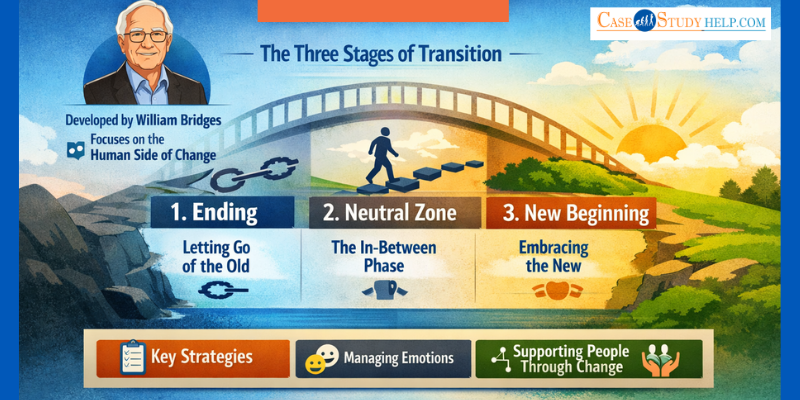
The main Stages of Bridges Transition Model are as follows:
Ending, Losing, and Letting Go
This is the first stage of the Bridges Model of Change Management. It starts wen the staff leer about the new changes and are usually made by the resistance and also sometimes an emotional upheaval. But in order to make this transit work, we need to first accept the ending in old always to the work, routines, behaviours, roles as well relationships.
At this stage, the employee might get confused and feel an uncertainty about the new changes in the organization. Here, the key emotions include fear, anger, denial, confusion, sadness, loss or frustrate. The leadership task here can recognize what the people are really losing and accept the resets as quiet natural and to support them and adjust y leaving the old ways behind.
The Neutral Zone:
when the people let go of the first stage, they enter into an in between or a neutral zone. This zone typically has many similar elands to that of the first stage but it is more indices towards more confusion, uncertainty or impatience. This is an in between stage where the old working ways are no longer present and the new ways are also not formed fully.
Due to this the individuals can feel confused which can turn in to low productivity and low leads. The individuals can suffer from anxiety and can question their roles and doubt where tis can he can lead really lead to positive outcomes.
At this stage, the key emotions are scepticism, impatience, curiosity and confusion. Here, the task of the leaders is to have a very clear as well frequent communication with the staff and set some short team goals for Kemp the progress ongoing and encore the people to test the new changes and ideas.
The New Beginning:
This is the final of the Bridges Change Model stages and it is the new beginning where it is marked by the release of a new energy and a goo acceptance from the team. At this stage the individuals can adopt a calmer as well a more positive attitude towards their new identities and organizational roles. Here, the leaders need to clarify as well explain very clearly how this new beginning can evolve and then assure the team towards a better direction as well stability.
The key emotions here are confidence, energy, acceptance and enthusiasm. At this stage, the main responsibly of the leaders is to support a proper training, adjust to the systems, celebrate early success and regard the employees in order to encourage them.
Unlock a deeper understanding of the Bridges Transition Model of Change with our comprehensive guide. If you need expert assistance with your assignments, contact us today for high-quality, plagiarism-free academic support.
👉 Get Expert Guidance
Applying the Bridges Transition Model in Change Management
The Bridges Transition Model in change management manage the human psychological side of the organizational change rather than just the procedure. It breaks own the change into 3 main stages- ending (letting go), the neutral zone (uncertainty) and the new beginning (adoption).
Success of this management model depress on guiding the employees via all these emotional stages to improve their morale and reduces the resistance. Applications of tis business Management model are as follows:
- Mapping the Stakeholders: identifying who is the most picked among the major stakeholders of the company and their likely emotional position on the curve of transition.
- Equipping the Managers: this is to train the leaders to act as empathetic coaches and not just project managers to guide the trams through uncertainty.
- Integrating with the Plans: embedding the transition activities like feedback session, communications, into an overall project management schedule.
- Monitoring and Adapting: this is measuring the emotion sentiment and not just productivity for identifying as well supporting people who are struggling during this transition period.
Unlike the process driven models this Bridges model focuses mostly on earning the people to move via the internal and the emotional journey.
Real-World Example of the Bridges Transition Model
A real world Bridges Transition Model example is the “Atlassian’s transition to the “Team Anywhere” policy (2020–2021).” Since the company adopted the remote working permanently they have navigated the 3 stags of the model through a hybrid neutral zone of the new policies.
The Atlassian Case Study Analysis is as Follows:
- Ending, Losing, and Letting Go: Atlassian had recognized that any traditional office centric work was over then. They addressed the employee fears as well the loss of the in person iterations that used to take place daily and in this way they could manage the transition to a new working day.
- During the transition to the “Team Anywhere” model, staff morale and productivity fluctuated. Atlassian had to manage employee confusion around remote work while developing the necessary remote-first tools, work culture, and team norms.
- The New Beginning: Atlassian had fully embraced the policy f “team anywhere” where the employees could work from almost anywhere. They materialized this new stage by enhancing all the necessary virtual collaboration tools by updating the performs Maben to focus on the necessary outcomes rather that were hopes to establish new communicate methods.
Limitations and Criticisms of the Bridges Change Model
While the Bridges Change Model framework is very widely celebrated globally by many organizations, but it has certain limited too. These are state below:
Lack of a Structured Process: the model do not provide any guidance on how it progresses and track well how the people are rally adopting to the change or use any performance measurements.
Narrowing the Focus: this model focuses too much on people’s emotions which can also miss the real issues in business. Sometimes, it can also ignore the market culture, condition and the leadership influence.
Simplifying the Complexity of Human Nature: the model works on the assumption of people can move through different stages in one order that always cannot be true.
Scalability and Resource Issues: this model works the best for the smaller teams but it can be tougher for the bigger organizations.
Depends on the Leadership Skill: it always needs the team leaders to have a very high emotional intelligence in order to guide the teams on the right track.
Comparing the Bridges Transition Model with Other Change Management Models
The Bridges Transition model mainly focuses on the internal, psychological and the emotional procedure the staffs experience during any organizational changes like ending, neutral zone and the new beginning.
It uses the internal parameters rather than external tactical steps to chafe the manager. It is used to address the humane side of the change by focusing on letting go of the old pattern and to embrace the new one.
Comparison With the Other Management Change Models:
Kotter’s 8-Step Process:
The kotter model provides a very structured, step by step and a top down roadmap for the implementation like building coalition or creating any urgency. The bridges change model is more empathic and focuses on man dug the psychological transition while the kotten change model focused on the driving procedure.
Prosaic/ADKAR Model:
The full form of ADKAR is Awareness, Desire, Knowledge, Ability, Reinforcement and is an action oriented as well individual focused model. While the Bridges model has a more holster approach regarding the various emotional stages , the ADKAR model focuses more on the checklist for the individual changes in adoption.
Lewin’s Change Model:
The Lewis change model is based m unfreeze, change and refreeze. It has a very common 3 stge approach. But this model is often edged as a more rigid as well linear while the bridges chef model focuses more deeply on the psychological journey of the employees.
Kübler-Ross Change Curve:
This business model maps the emotional stages of grief like anger, deniel, etc. to change an focuses very much on the emotional reactions due to resistance. While the bridges model is much broader in approach and organizes the reasons into various stages to manage the long term organizational changes.
Useful Tools for Writing and Reviewing Management Assignments
The AI Writing Tool Examples are as Follows:
- Grammarly: it is useful for editing and proofreading as a software tool.
- Paprpal: it is a software tool that is extensive used for research writing.
- Quill boat: this is used for good paraphrasing work.
- Jenni AI: this software tool is used to enhance readability.
- Hemingway Editor: it gives you a very good citation support.
Research and Reserve Management Tools:
- Zoster
- Mendeleyev
- Google scholar
- Connected papers
Organization and the Productivity Tools:
- Trello
- Notion
- Forest
- Focusmate
Collaboration and the Drafting Tools
- Google docs
- Microsoft 365 co-pilot
- Overleaf
Visualization Tools for Management:
- Canva: it is useful to create the professional graphics like the SWOT analysis, PESTEL analysis, charts, graphs and also the infographics for enhancing the report and the presentations.
- Xmind: it is a free mind mapping tool for the brainstorming procedure and to structure the ideas before starting to write.
Final Thoughts
As the Bridges Transition Model explained in this bog, you can see that following this model accurately in your business management assignment paper is not an easy job. Thus, you always need the best online assignment writing help services. The Casestudyhelp.com is always the top choice for you in this regard.
Why Casestudyhelp.com?
- We are always the best online assignment writing service providers
- Top grades are assured by us
- Only original and plagiarism free content is provided by us
- Top writers work with us in a team
Thus, join us soon.
Author Bio:

Hi, I’m Lyana Jones, a passionate academic writer and the voice behind this blog. With years of experience in crafting academic content, I’m here to help you turn your ideas into polished, high-quality work.
Whether you need guidance or full writing support, I’m always happy to help. Reach out anytime and get expertly written, plagiarism-free content with perfect grammar and structure.